Narcissism in the Workplace: What It Looks Like and Why It Matters
Narcissistic behavior at work is often easiest to recognize after someone has gained enough authority to influence assignments, evaluations, recognition, or promotion.
At first, the same person may look impressive. Confidence can read as competence, persistent self-promotion as ambition, and a willingness to dominate discussion as leadership.
The difference often appears when that person becomes a manager. Someone who seemed decisive may react badly when a subordinate corrects them, resent an employee who receives more praise, or refuse to acknowledge that a decision they defended was wrong.
Those reactions become a workplace problem when they affect who gets heard, who receives credit, who is trusted, and who pays a professional price for disagreeing.
How Narcissistic Managers Respond to Disagreement
A supervisor may say they want employees to challenge weak ideas, then become noticeably colder toward the people who do. One person questions an unrealistic deadline and later gets described as negative. Another points out a flaw in a plan and stops being invited to meetings where the plan is discussed.
Coworkers notice the connection. They begin softening criticism, withholding concerns, or waiting for someone else to raise a problem first because they have seen how disagreement changes the manager’s treatment of people.
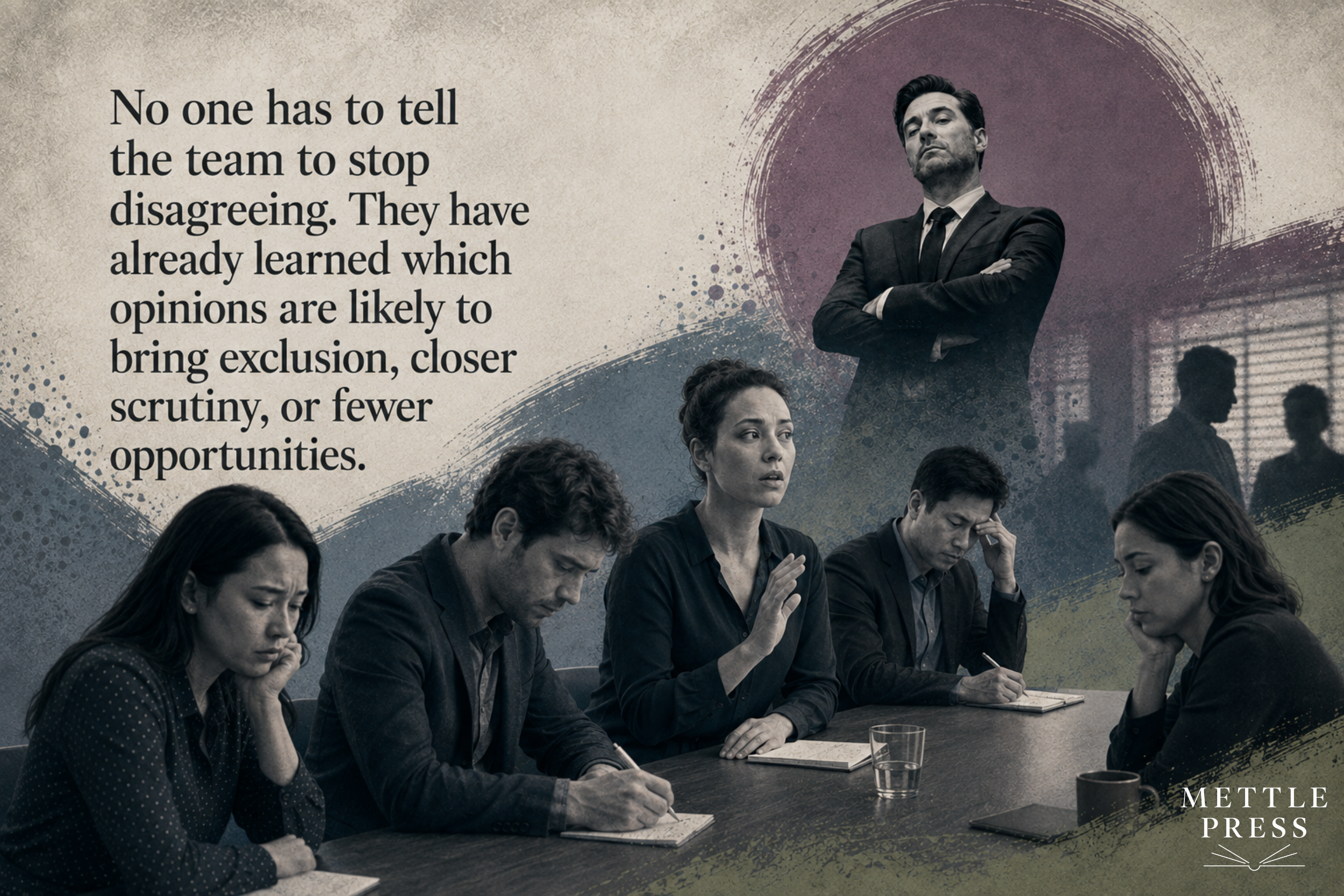
No one has to tell the team to stop disagreeing. They have already learned which opinions are likely to bring exclusion, closer scrutiny, or fewer opportunities.
When employees begin filtering what they tell a manager, warnings, conflicting evidence, and practical concerns may never reach the person making the decision. A risk discussed plainly among coworkers may be downplayed when the manager is present. Evidence that contradicts the manager’s chosen course may be left out entirely. Problems may remain unreported until they have already affected deadlines, budgets, clients, or staff.
Senior leadership may interpret the lack of disagreement as confidence in the manager’s judgment. The manager may instead be making decisions without hearing the objections and warnings employees have learned to keep to themselves.
How Narcissistic Workplace Dynamics Affect Credit and Opportunity
Workplaces are never perfectly fair about recognition. People forget names, summarize team efforts badly, and sometimes receive praise they did not seek.
More concerning is a repeated pattern in which one person claims credit for successful work but blames others when something goes wrong.
An employee develops an idea, but the manager presents it to senior leadership as their own strategy. When a project succeeds, the manager emphasizes their role in directing it. When the next project fails, they blame the employees who carried it out.
Credit affects who gets promoted, who is trusted with high-profile projects, who is introduced to senior leaders, and whose name is remembered when raises, promotions, or new responsibilities are discussed. When a manager repeatedly takes credit for other people’s work, the organization can end up rewarding the person who presents the success most convincingly rather than the people who produced it.
Favoritism can influence those outcomes as well. Employees who flatter the manager, defend them during conflict, or back their account of a disputed event may receive more desirable projects, greater access to senior leaders, or more forgiveness for mistakes. That treatment may change once the employee begins receiving praise that does not reflect back on the manager or stops agreeing with them.
Employees notice when praise, assignments, and access start going to the people the manager favors. They may begin wondering whether accepting public praise will damage the relationship, whether correcting the boss will cost them a desirable assignment, or why one colleague keeps being chosen for high-profile projects after defending the manager during disputes.
When Employees Start Managing the Manager
Employees can lose substantial work time anticipating and managing a supervisor’s reactions.
One employee becomes the person who delivers bad news because they know how to do it without triggering an argument. Staff rehearse routine conversations before going into the manager’s office. New hires are quietly warned about topics that may lead to anger, criticism, or retaliation. Someone allows the manager to take public credit because challenging them would likely create another conflict.

Time that should be spent solving problems, making decisions, or completing work is instead spent trying to prevent the manager from reacting badly.
A client problem may require one discussion about the solution and another about how to explain it without triggering defensiveness or hostility. A team comparing ideas may spend part of the meeting deciding which recommendation is least likely to be taken as criticism. Reporting a mistake can involve choosing who should raise it, when to do so, and which details are safest to mention first.
The department may still hit its targets. Senior leaders may still see completed projects, strong sales, satisfied clients, or polished presentations. They may not see the time employees spend carefully wording concerns, preparing for tense conversations, or trying to prevent anger, blame, or retaliation from disrupting the work.
The team may remain productive while employees become less willing to speak plainly, challenge weak decisions, or disagree without worrying that the conflict will affect how they are treated afterward.
How Workplace Power Can Distort Accountability
People can remember the same workplace conversation differently, misunderstand instructions, or become defensive when something goes wrong.
The imbalance is greater when one of those people also writes the evaluation, documents the incident, or influences what senior leadership is told.
A deadline is missed after priorities change several times, but the performance review describes poor time management. An employee reports being humiliated in a meeting, and the discussion shifts to how they raised the complaint rather than what the manager said or did. A supervisor gives a verbal instruction, denies giving it after the decision fails, and then writes the employee’s evaluation.
The employee may now have to deal with both what happened and what gets written down about it, especially if that record could affect a raise, promotion, disciplinary decision, reference, or future assignment.
Some employees respond by creating a paper trail. They follow verbal directions with email, record changes to deadlines or priorities, and bring another person into meetings that once would have happened privately.
Documentation does not prove narcissism. It may show that employees no longer trust a manager’s later account to match what was said, decided, or assigned.
How to Protect Yourself When You Work for a Narcissistic Manager
When important instructions, deadlines, priorities, or responsibilities change, keep a written record. Follow verbal directions with email when necessary, and preserve drafts, project histories, presentations, and messages that show what you contributed.
If treatment changes after you disagree or raise a concern, document what changed and when. That may include assignments, access to meetings, evaluations, scrutiny, or opportunities. When reporting a problem, describe the conduct rather than trying to prove a diagnosis. “My assignment changed two days after I raised this concern” gives an employer something specific to review.
Use appropriate internal channels when the conduct involves retaliation, discrimination, harassment, threats, or consequences for your employment. Keep copies of records you are permitted to retain.
It is also reasonable to consider what staying is costing you. Leaving is not always practical or necessary, but some organizations continue protecting managers whose results they value. If repeated reports produce no investigation or change, employees may also need to consider whether the organization is willing to address the manager’s conduct.
Why Organizations Miss Patterns of Harmful Management
Organizations rarely announce that a successful manager will be protected despite repeated complaints. More often, each complaint, resignation, or transfer is treated as a separate event.
One employee transfers, another resigns, and someone else stops volunteering for high-profile assignments. Human resources receives complaints months apart and reviews each one without comparing it with earlier reports. Senior leadership continues to see a manager who hits revenue goals, retains clients, or delivers projects on time.
Each event is explained differently. The resignation was a career move. The transfer was a personality conflict. The complaint was a communication problem.
Unless someone compares the complaints, departures, and shifts in who volunteers for visible projects, the same manager can appear in one incident after another without the organization connecting them.
Several employees reporting retaliation after disagreement warrant more scrutiny than one conflict viewed alone. The same is true when performance evaluations worsen after complaints, credit disputes repeatedly involve the same manager, or one team has unusually high turnover.
Employers do not need to decide what personality traits a manager has before comparing those reports. They can review complaints side by side, examine who created and owned the work, require written reasons for promotions, discipline, reassignment, or termination, gather feedback from direct reports, and check whether an employee’s treatment changed after raising a concern.
The employer may never know why the manager behaved that way. It can still determine whether complaints about retaliation, credit, evaluations, or turnover repeatedly involve that manager.
Why Specific Behavior Matters More Than the Narcissist Label
Calling a manager a narcissist can help someone identify a pattern in behavior that seemed inconsistent or difficult to explain. The label becomes less helpful when it replaces a clear description of what the manager actually did.
An employee may never know why a manager took credit, reacted badly to criticism, or changed their treatment after a disagreement. The motive may involve narcissistic traits, insecurity, ambition, resentment, or a combination of factors.
What the employee can describe is what happened:
My work was presented without my name. My assignments changed after I objected. Criticism appeared in my evaluation after I complained. The written record did not match the instructions I received. Several coworkers reported comparable treatment without coordinating their accounts.
Emails, drafts, meeting records, witnesses, personnel decisions, and earlier evaluations can show whether those events occurred as described.
This also prevents narcissism from being used to explain every controlling, dishonest, vindictive, or abusive manager. Credit theft, retaliation, intimidation, and manipulation can occur for reasons unrelated to narcissistic traits, and people with narcissistic traits do not all behave in the same way.
Research has found associations between narcissistic traits and counterproductive work behavior, as well as between leader narcissism and reduced employee voice. It cannot establish why one manager took credit, punished disagreement, or changed an employee’s treatment, and it cannot prove what happened in a specific workplace dispute.
What Employers Should Look for in a Narcissistic Workplace Dynamic
The employer does not need to decide whether a manager is a narcissist. It does need to examine conduct that may be excused when the manager brings in revenue, delivers visible results, or has strong support from senior leadership.
A manager can meet targets while employees become less willing to correct mistakes, challenge weak decisions, claim credit for their own work, or report concerns because they fear losing assignments, access, favorable evaluations, or opportunities for advancement. Whether narcissistic traits help explain the manager’s behavior or not, the employer still has to address the retaliation, credit theft, intimidation, or unequal treatment employees are reporting.
The evidence may already exist in project drafts, meeting records, performance reviews, assignment histories, turnover records, complaints, and accounts from employees who worked under the same manager.
The employer then has to decide whether strong performance excuses conduct that leaves employees less willing to challenge weak decisions, claim credit for their own work, report problems early, or trust that promotions, evaluations, and assignments will be based on their actual performance rather than the manager’s personal reactions.